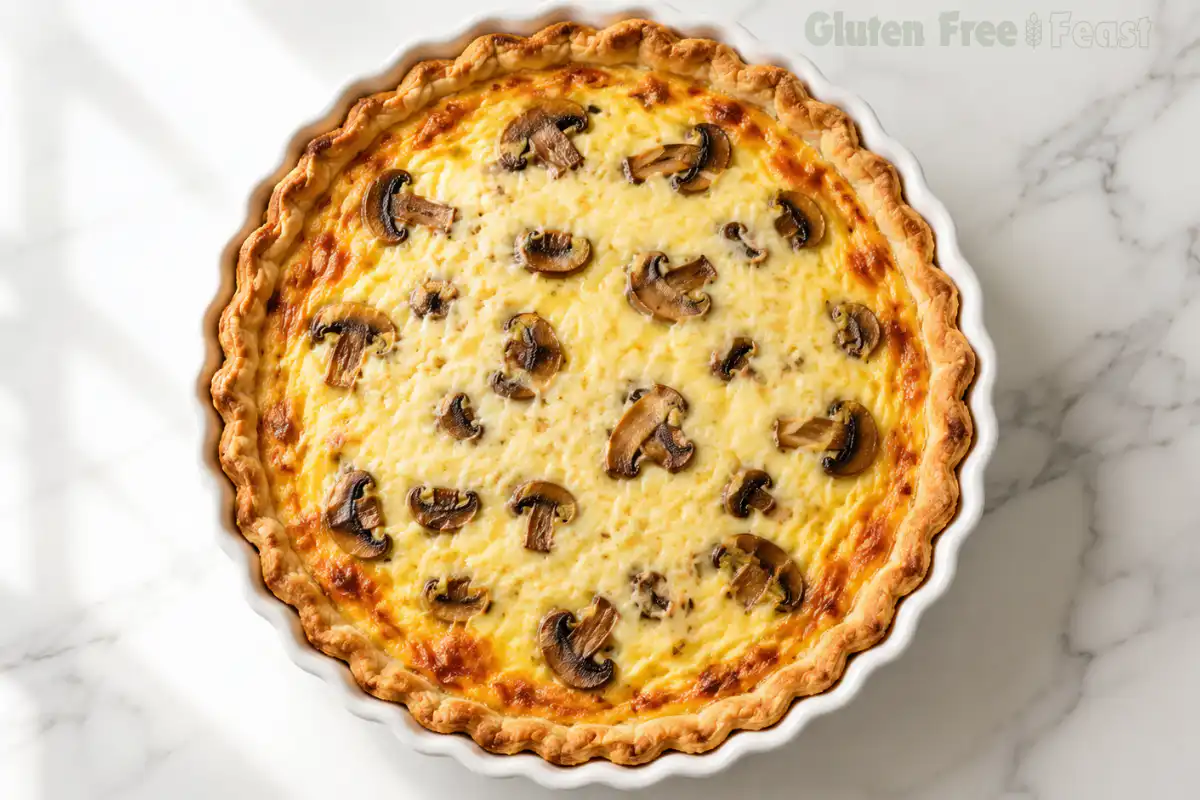
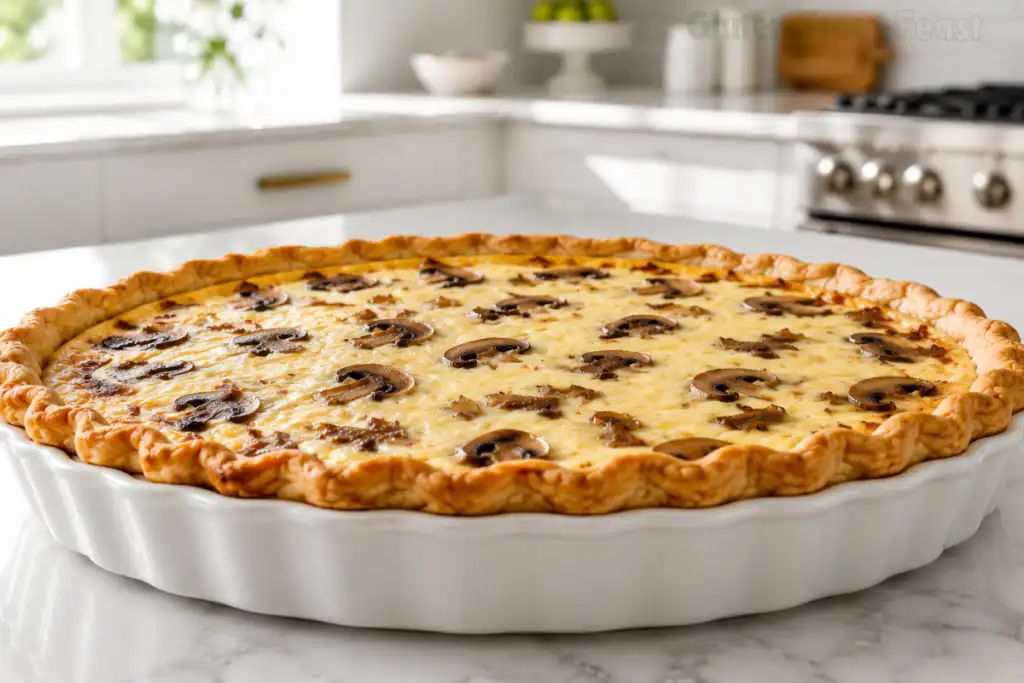
There is no good reason a quiche should be off the table for anyone eating gluten free. The filling is eggs and cream and cheese, nothing complicated, nothing that needs wheat. The crust is where most recipes either give up (frozen GF shell, crumbly disaster) or bury a link to a separate recipe you have to open in another tab. This recipe does neither. Everything is right here on one page: a from-scratch, certified gluten-free pie crust that rolls, transfers, and holds its shape, plus a creamy mushroom Gruyère filling that sets into clean slices.
I spent four rounds of testing on the crust alone, adjusting the fold-and-turn technique and the chill time before I was satisfied. The filling was easier, but the ratio of egg to cream is precise, and the temperature of your dairy the moment it goes into the bowl matters more than you might expect. I will walk through both in full below, with the reasoning behind each step.
This is the gluten free quiche recipe I now make for weekend brunch when I want something that looks like it took effort and tastes like it actually did.
Key takeaways
A gluten free quiche recipe needs two things to succeed: a certified GF flour blend for the crust (Better Batter, Bob’s Red Mill 1-to-1, and King Arthur Measure for Measure all perform well) and a certified GF baking powder such as Rumford or Clabber Girl. The filling is built on a 1/4-cup-of-liquid-per-egg ratio using room-temperature eggs and half and half, which keeps the custard from curdling and produces a smooth, even set. The crust parbakes at 425°F for 15 minutes, then the assembled quiche bakes at 350°F for about 35 minutes, followed by a 20-minute rest before slicing. This recipe serves 8 and is 100% celiac-safe when every packaged ingredient carries a certified gluten-free label.
Best flour: certified GF 1:1 blend · Bake: 350°F, ~35 min · Total time: ~2.5 hrs · Yield: 8 slices
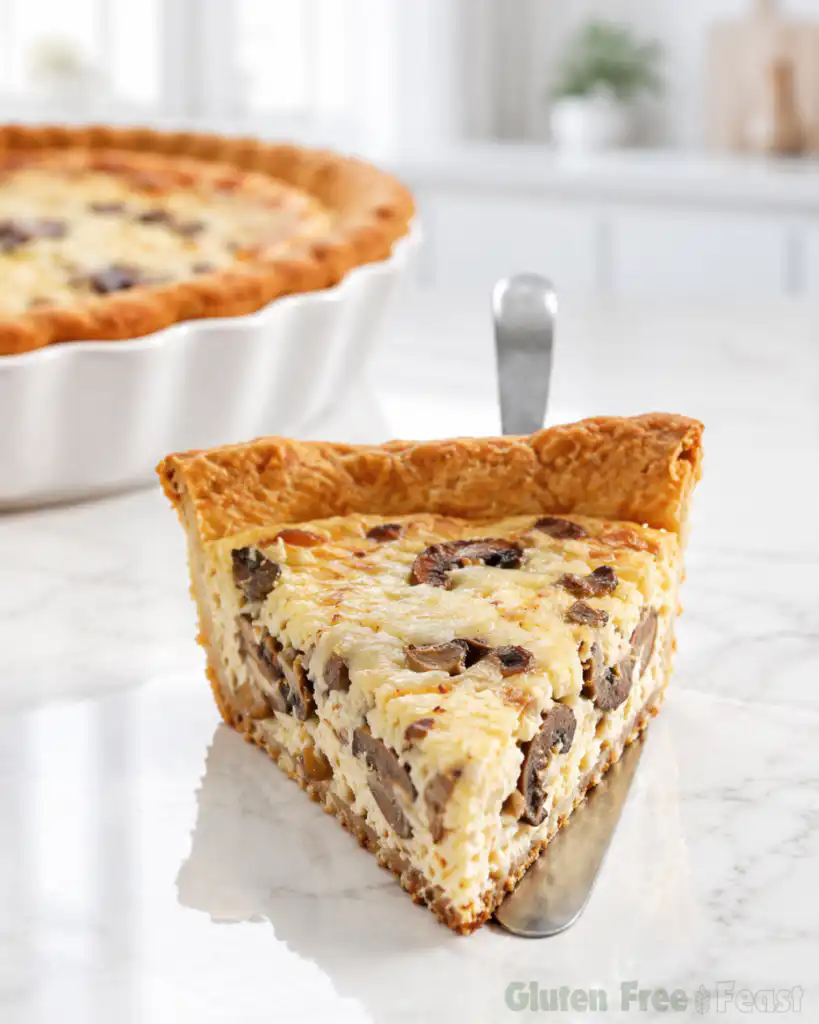
Table of Contents

Gluten Free Quiche Recipe
Ingredients
Equipment
Method
- Whisk together the certified GF flour blend, xanthan gum (if your blend does not already contain it), certified GF baking powder, and salt in a large mixing bowl.
- Add the cold, diced butter and toss each piece to coat it in the flour. Using your fingers, flatten each chunk to about 1/8-inch thickness. You want flat, irregular pieces, not crumbs.
- Make a well in the center. Pour in the iced water slowly, stirring gently just until the dough begins to come together. Add more water by the teaspoon if dry patches remain. Press into a rough disk.
- Turn the dough onto a lightly floured surface. Roll into a rough rectangle about 1 inch thick, fold in thirds like a letter, then roll out again. Repeat once more, ending at about 1/2 inch thick. Fold into thirds once more, wrap in plastic wrap, and refrigerate 30 to 60 minutes until firm.
- Preheat the oven to 425°F. Grease a 9-inch deep dish pie plate.
- Roll the chilled dough on lightly floured parchment to a 10-inch round, about 3/8 inch thick. Transfer to the pie plate using the rolling pin. Press into the bottom and sides. Trim to a 1/4-inch overhang, tuck under, and crimp all the way around. Pierce the bottom with a fork. Place the pie plate in the freezer for 10 minutes.
- Line the crust with parchment and fill with pie weights or dried beans. Bake at 425°F for 15 minutes until the edges just begin to show color. Remove the weights and parchment. Reduce the oven to 350°F.
- Melt the butter with the olive oil in a saute pan over medium heat. Add the diced onion and cook for about 1 minute, stirring frequently.
- Add the mushrooms, salt, and pepper. Cook for approximately 10 minutes, stirring occasionally, until the mushrooms are browned and any liquid has completely evaporated. Drain off anything remaining.
- In a medium bowl, beat the room-temperature eggs with the room-temperature half and half until smooth and well combined.
- Scatter half the grated Gruyere over the bottom of the parbaked crust. Add the cooked mushroom and onion mixture in an even layer. Scatter the remaining cheese on top. Pour the egg and half-and-half mixture over everything.
- Bake at 350°F for approximately 35 minutes, until the edges are set and lightly golden and the center has a slight, even jiggle when you move the pan side to side. Do not wait for the center to be completely still.
- Transfer the quiche to a wire rack and rest for at least 20 minutes before slicing. The custard continues to set as it cools. Serve warm.
Notes
Why You Will Love This Gluten Free Quiche Recipe
- Complete on one page. The full from-scratch crust method is here. No clicking to a separate recipe and no piecing things together from two tabs.
- 100% celiac-safe. Every ingredient that can hide gluten is called out by name, with certified GF specifications so nothing slips through.
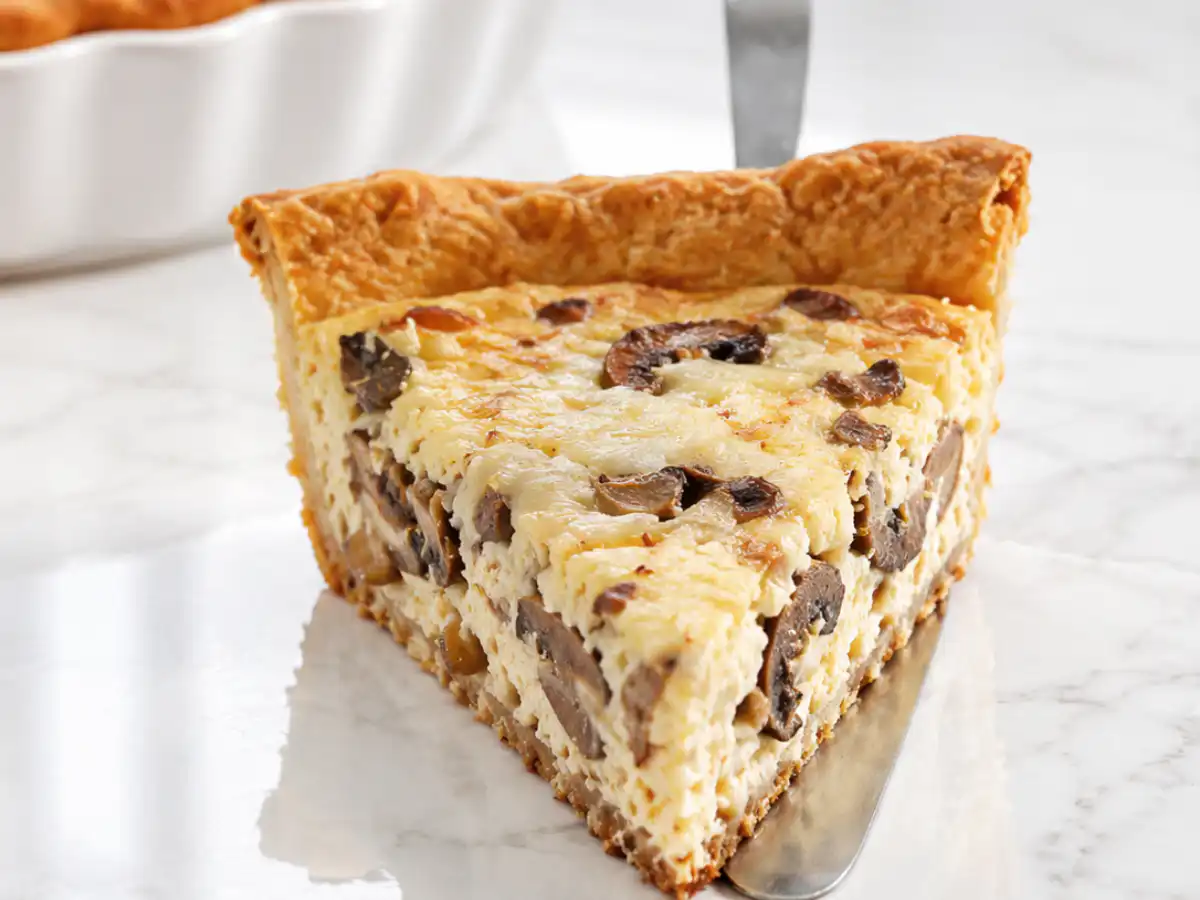
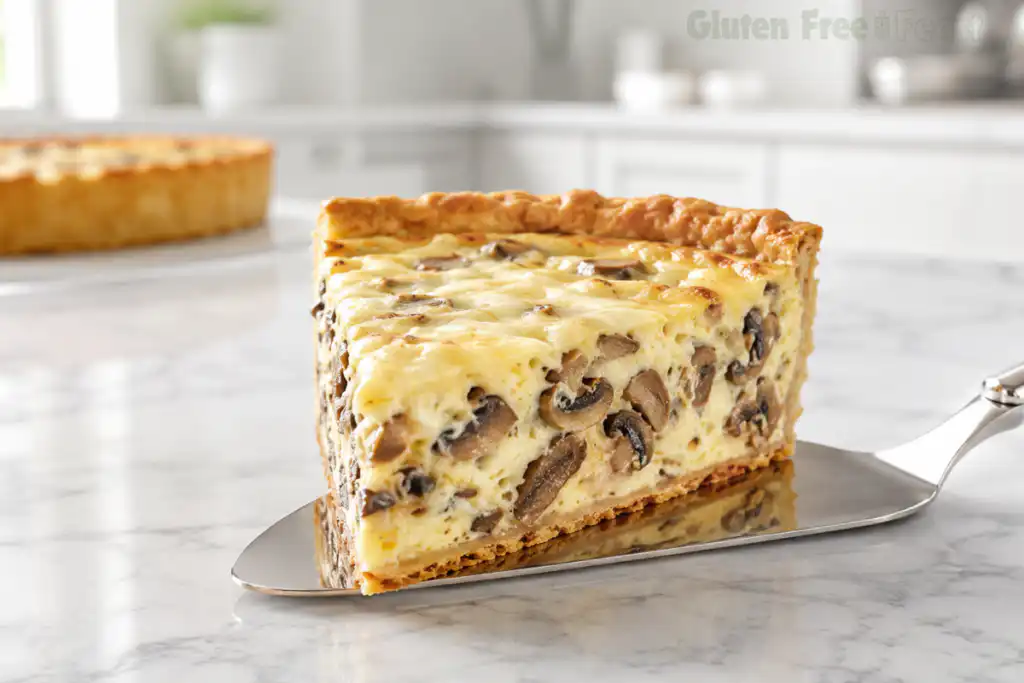
- A crust that actually works. The fold-and-turn technique builds visible layers in the dough, giving you a crust that holds together and shatters cleanly when you cut it.
- Creamy, properly set custard. The egg-to-cream ratio is exact, and the room-temperature rule for your dairy is the detail that separates a silky result from a grainy one.
- Flexible fillings. The mushroom and Gruyère version here is the classic starting point, but the base recipe works with almost any filling you want to put in it.
- Dairy-free option included. A full swap table is in the Substitutions section.
- Make-ahead friendly. You can parbake the crust a day ahead, and the finished quiche freezes well for up to three months.
Is Quiche Normally Gluten Free?
No. Standard quiche crust is made with wheat flour, which is not safe for celiac disease. The filling itself (eggs, cream, and cheese) is naturally gluten free, but the crust makes most restaurant and store-bought quiche off-limits.
Cross-contamination is a second problem even at restaurants that claim a gluten-free option. A quiche baked in pans previously used for wheat-flour pastry, or rested on a counter dusted with regular flour, can carry enough gluten to trigger a reaction. The only reliable answer is making it yourself with certified GF ingredients and clean equipment.
This gluten free quiche recipe uses a certified GF flour blend for the crust, making the entire dish safe for celiac disease. It directly answers the question most people are really asking: can a gluten free person eat quiche at all? Yes, from scratch, and it is worth making.
Ingredients
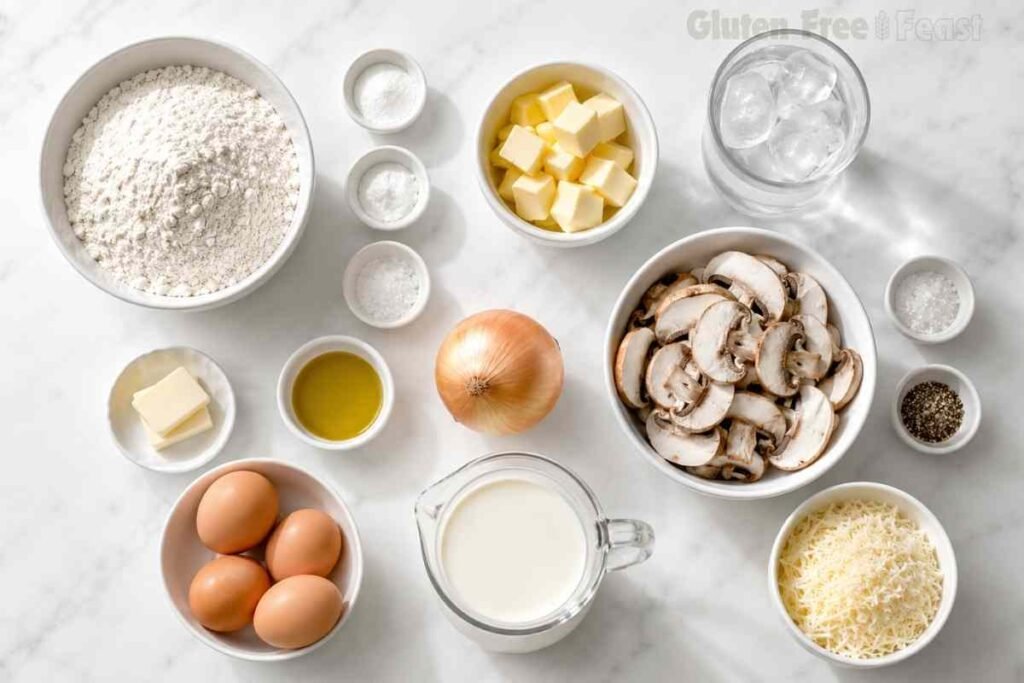
For the GF Pie Crust
- 2 cups (280g) certified GF all-purpose 1:1 flour blend with xanthan gum (Better Batter, Bob’s Red Mill 1-to-1, or King Arthur Measure for Measure all work well; see notes below)
- 1 tsp xanthan gum (omit if your blend already contains it)
- ⅓ tsp certified GF baking powder (Rumford or Clabber Girl)
- ⅓ tsp kosher salt
- 8 tbsp (112g) unsalted butter, diced into ½-inch pieces and kept cold
- ½ cup (4 fl oz) cold iced water, plus more by the teaspoon as needed
For the Filling
- 2 tbsp (28g) unsalted butter
- 1 tbsp (14g) extra virgin olive oil
- 1 small yellow onion, peeled and diced
- 1 lb (16 oz) white or baby portobello mushrooms, sliced
- ½ tsp kosher salt
- ⅛ tsp freshly ground black pepper
- 4 large eggs (about 200g), at room temperature
- 1⅓ cups (10.66 fl oz) half and half, at room temperature
- 8 oz Gruyère cheese, grated from a block at home
Ingredient Notes and Substitutions
GF flour blend. Not all certified GF blends behave the same way in a pastry crust. After testing three leading options, Better Batter produced the most consistent flakiness and the cleanest transfer from the rolling surface. Bob’s Red Mill 1-to-1 and King Arthur Measure for Measure both perform reliably, with the King Arthur version giving a slightly crispier edge. What does not work: single-ingredient flours like almond flour or coconut flour on their own. They absorb liquid at completely different rates and will not give you a pliable, rollable pie dough.
Certified GF baking powder. This is the ingredient most home bakers miss. Many standard baking powder brands use wheat starch as a filler, making them unsafe for celiac disease. Rumford and Clabber Girl are both certified GF and available in most grocery stores. The amount here is small, but the risk is real if you skip the check.
Xanthan gum. GF doughs lack the gluten network that makes wheat pastry elastic. Xanthan gum does the structural work instead, binding the dough together so it can be rolled and transferred without cracking. Check your flour blend label before adding any; most 1:1 blends already include it. Adding it on top of a blend that already contains it results in a gummy, dense crust.
Eggs and half and half, at room temperature. Cold dairy added to the filling can cause the custard proteins to seize unevenly during baking, producing a slightly grainy or curdled texture. Room-temperature ingredients come up to heat more gradually, which gives the proteins time to set smoothly. I tested this side by side in multiple rounds: cold dairy produced a noticeably less even set. Thirty minutes on the counter before you start is enough.
Gruyère. Block Gruyère grated at home is the right choice here. Pre-shredded cheeses can contain anti-caking agents, some starch-based, so grate from a block at home to remove the uncertainty. Asiago, Jarlsberg, or sharp white cheddar all work if Gruyère is not available.
Celiac Safety Note: Please ensure all packaged ingredients carry a certified gluten-free label. For this recipe, check specifically: your GF flour blend, your baking powder (Rumford or Clabber Girl), and any bacon or cured meat used in variations. Pre-shredded cheese may contain starch fillers, so grate from a block at home. Cross-contamination at packaging facilities is a real risk for people with celiac disease. When in doubt, look for the certified GF symbol.
What Can I Use Instead of Pie Crust for a Quiche?
Three options work well when you want to skip or swap the traditional crust.
Crustless quiche. Grease a 9-inch deep dish pie plate generously and pour the filling straight in. Baking time and temperature stay the same. The quiche sets into clean slices with no pastry edge, which some people actually prefer for a lighter result.
Certified GF store-bought crust. A few brands now make GF pie crust shells. Parbake it first at 425°F for 15 minutes before adding the filling, following the same method described below.
Almond flour crust. A grain-free almond flour pastry works with this filling. The texture is denser and more crumbly than a traditional crust, but it holds together once the quiche sets. Confirm your almond flour is certified GF if celiac disease is a concern.
How to Make This Gluten Free Quiche Recipe
Step 1: Make and Chill the GF Pie Crust
Whisk together the certified GF flour blend, xanthan gum (if your blend does not already contain it), certified GF baking powder, and salt in a large mixing bowl. Add the cold, diced butter and toss each piece to coat it in the flour. Using your fingers, flatten each chunk to about ⅛-inch thickness. You want flat, irregular pieces, not crumbs. Those butter pieces are what create flaky layers.
Make a well in the center of the flour mixture. Pour in the iced water slowly, stirring gently just until the dough begins to come together. Add more water by the teaspoon if dry patches remain. Press into a rough disk.
Now the step most GF pie crust recipes skip: the fold-and-turn. Turn the dough onto a lightly floured surface and roll it into a rough rectangle about 1 inch thick. Fold it in thirds like a letter, then roll it out again. Repeat once more, ending with dough about ½ inch thick. I do this because GF dough cannot build gluten layers through lamination the way wheat dough does. The mechanical folding creates the same result by physically stacking butter and dough. In my side-by-side tests, the folded dough had noticeably more layers and held its shape better during parbaking than dough that went straight from mixing to rolling.
Fold into thirds once more, wrap in plastic wrap, and refrigerate for 30 to 60 minutes until firm.
Step 2: Shape and Parbake the Crust
Preheat the oven to 425°F. Grease a 9-inch deep dish pie plate.
Remove the chilled dough and roll it on lightly floured parchment to a 10-inch round, about ⅜ inch thick. Transfer to the pie plate by rolling the dough loosely around the rolling pin and unrolling it over the plate. Press it into the bottom and sides. Trim to a ¼-inch overhang, tuck it under, and crimp the edges all the way around. Pierce the bottom with a fork. Place the pie plate in the freezer for 10 minutes.
Line the crust with parchment and fill with pie weights or dried beans. Bake at 425°F for 15 minutes, until the edges just begin to show some color. Remove the weights and parchment. Reduce the oven to 350°F.
Parbaking is not optional. The filling has about 35 more minutes of baking time ahead of it, and wet custard sitting on raw dough will never let the bottom cook through properly. The weights keep the sides from slumping before the structure sets.
Step 3: Cook the Filling
Melt the butter with the olive oil in a sauté pan over medium heat. Add the diced onion and cook for about 1 minute, stirring frequently. Add the mushrooms, salt, and pepper. Cook for approximately 10 minutes, stirring occasionally, until the mushrooms are browned and any liquid they have released has completely evaporated. If liquid is still pooling in the pan, keep cooking. Drain off anything remaining before you move on.
This step matters. Mushrooms release a significant amount of water as they cook, and that moisture will dilute the custard ratio and produce a watery, loose set if it goes into the quiche. The filling must go in dry.
In a medium bowl, beat the room-temperature eggs with the room-temperature half and half until smooth and well combined.
Step 4: Assemble and Bake
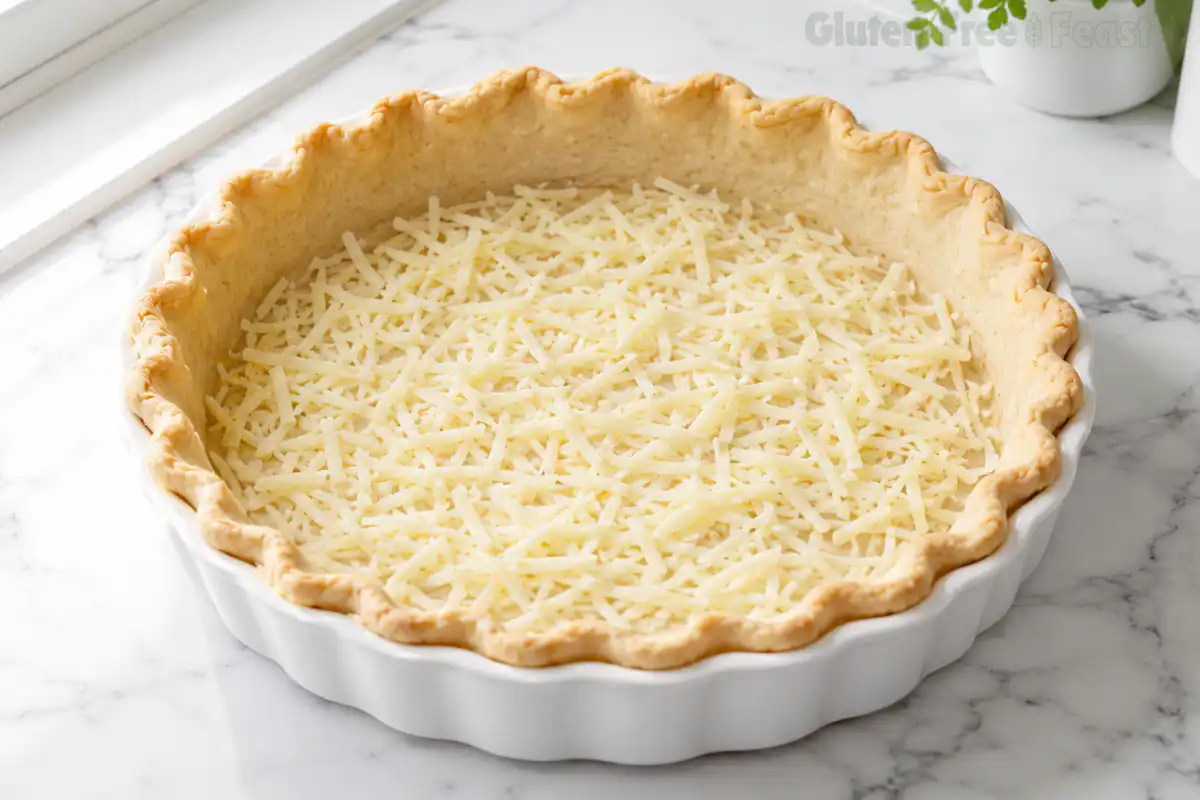
Scatter half the grated Gruyère over the bottom of the parbaked crust.
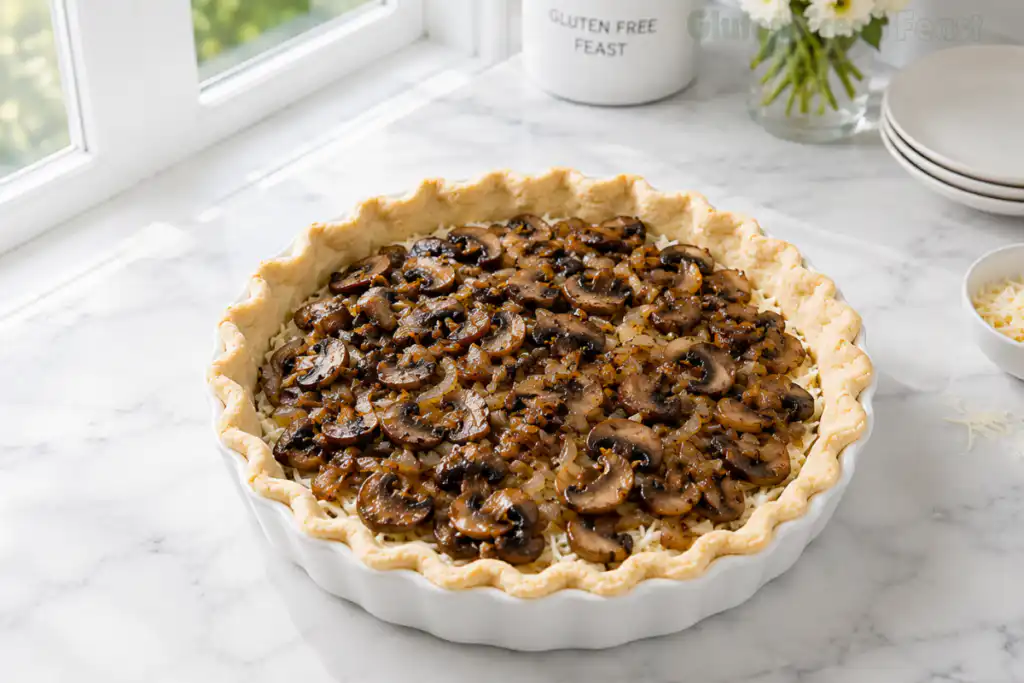
Add the cooked mushroom and onion mixture in an even layer.
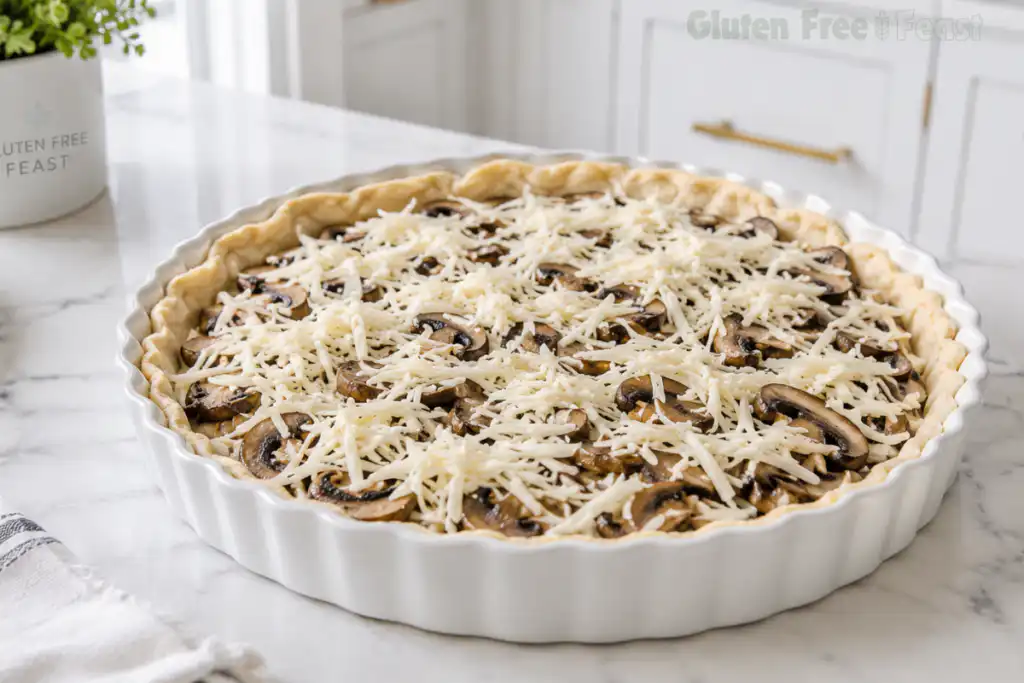
Scatter the remaining cheese on top.
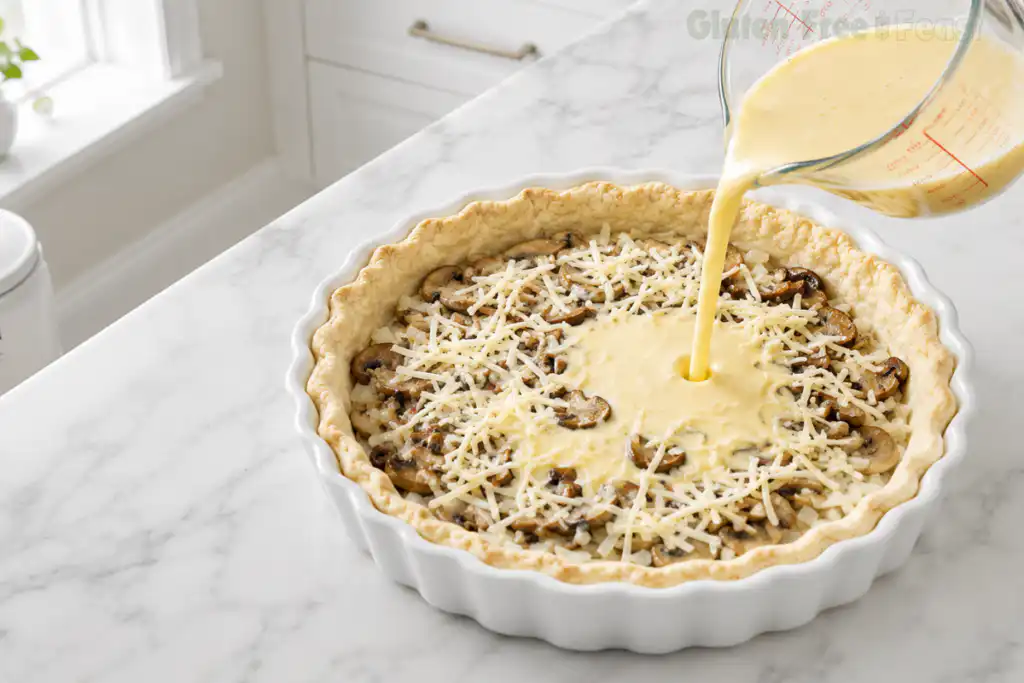
Pour the egg and half-and-half mixture over everything.
The layering order matters. Cheese on the bottom and top creates two anchor points that keep the filling from sliding when you cut it. The bottom layer melts into the custard during baking and distributes that flavor through every bite rather than concentrating it only on the surface.
Bake at 350°F for approximately 35 minutes. The quiche is done when the edges are set and lightly golden and the center has a slight, even jiggle when you move the pan side to side, similar to gently set gelatin. Do not wait for the center to be completely still in the oven. It will firm up as the quiche cools.
Step 5: Rest Before Slicing
Transfer the quiche to a wire rack and let it rest for at least 20 minutes before cutting. This is carryover cooking: the residual heat in the custard continues setting the proteins after the dish comes out of the oven, and the internal temperature keeps rising for a few minutes off the heat. Cut too early and you release steam and liquid, and the custard collapses into a soft, wet layer. Twenty minutes gives you clean, properly set slices every time. Serve warm.
Expert Tips for Best Results
- Keep the butter cold from start to finish. Chilled butter in pastry stays in distinct pieces through mixing and rolling. When those pieces hit the hot oven, they melt and release steam, and that steam is what separates the layers. Room-temperature butter just blends into the dough and gives you a compact, mealy crust instead of a flaky one.
- Do not overwork the dough. GF pastry is more fragile than wheat pastry because there is no gluten to hold it together under stress. Mix just until the dough comes together, then stop.
- Freeze the shaped crust before parbaking. Ten minutes in the freezer right before the crust goes in is the difference between sides that hold their shape and sides that slump down into the plate. The cold slows the butter from melting too fast before the structure sets.
- Cook mushrooms until genuinely dry. This is the most common reason quiche turns out watery. Ten minutes over medium heat is the minimum, and the mushrooms should look noticeably darker and shrunken before you pull them. Liquid still pooling in the pan means more time.
- Use a dedicated GF rolling pin and pie plate. For anyone with celiac disease, wooden rolling pins and scratched non-stick surfaces can harbor gluten from previous use. If your equipment has been used for wheat flour, wash it thoroughly with hot soapy water, or use pieces kept exclusively for GF baking.
- The jiggle test is your most reliable doneness signal. A slight, even wobble in the center means the custard is set correctly. A liquid slosh means more time. No movement at all usually means overbaked, and it will be rubbery once it cools.
Substitutions and Variations
Mushroom Gruyère (this recipe). The classic. Gruyère is the traditional French choice for this style of quiche, and baby portobellos hold up well through the 10-minute sauté without turning mushy.
Bacon Cheddar. Replace the mushroom and onion filling with about 6 oz of certified GF bacon (check the label, as many brands contain wheat fillers or are processed on shared lines) cooked and crumbled, plus 1 cup of sharp white cheddar. This is the Lorraine-style variation.
Spinach Feta. Use 1 lb of frozen spinach, fully thawed and squeezed very dry, in place of the mushrooms. Swap the Gruyère for crumbled feta. Feta is saltier, so taste the custard before adding any extra salt.
Asparagus Goat Cheese. Blanch 8 oz of asparagus cut into 1-inch pieces for 2 minutes, then blot dry. Use goat cheese in place of Gruyère. This one works particularly well for spring brunch.
Broccoli Cheddar. Substitute 10 oz of blanched broccoli florets, thoroughly blotted dry, for the mushrooms. Sharp cheddar in place of Gruyère.
Dairy-free swaps:
| Ingredient | Dairy-Free Swap |
|---|---|
| Unsalted butter (crust) | Melt or Miyoko’s vegan butter, kept cold |
| Unsalted butter (filling) | Miyoko’s or coconut oil |
| Half and half | Full-fat coconut milk or unsweetened almond milk |
| Gruyère | Violife or another certified GF dairy-free shredded cheese |
All variations above stay celiac-safe as long as every substituted ingredient carries its own certified GF label.
What to Serve With Gluten Free Quiche
Quiche works for breakfast, brunch, a light lunch, or dinner, which is part of what makes it worth the effort. For a weekend brunch table, a slice pairs well alongside a stack of gluten free pancakes and you get both the savory and the sweet without making two separate recipes. A simple green salad with lemon vinaigrette is the most natural lunch pairing, and roasted potatoes or a small fruit bowl round things out nicely for a full brunch plate.
If you are building a larger spread, gluten free blueberry muffins sit nicely alongside the quiche. You can make them the night before and warm them in a low oven while the quiche rests, so everything is ready at the same time. For more pairing ideas, the gluten free breakfast recipes on the site are a good place to browse.
Storage and Make-Ahead Instructions
Refrigerator. Cool the quiche completely, then cover and refrigerate for up to 3 days. Reheat individual slices in a 200°F oven for about 15 minutes. Microwaving works but tends to make the custard slightly rubbery.
Freezer. Freeze whole or in individual slices. Wrap tightly in plastic wrap, then add a layer of foil. Keeps well for up to 3 months. Defrost overnight in the refrigerator before reheating. Do not freeze the unbaked custard filling; the eggs and cream separate on thawing and will not recover their texture.
Make-ahead crust. The parbaked crust can be made 1 to 2 days ahead. Cool it completely, wrap in plastic, and store at room temperature. When you are ready to bake, go straight to the filling steps. This is the most practical make-ahead option because it splits the roughly 2.5-hour project into two shorter sessions.
Make-ahead custard. The egg and cream mixture can be whisked together and refrigerated up to 24 hours before using. Bring it back to room temperature for about 20 minutes before pouring so it does not shock the parbaked crust.
Why Trust This Recipe
With a background in laboratory science, I develop recipes the same way I approached lab work: with documented testing, controlled variables, and results that can be replicated in any home kitchen.
This recipe has been tested multiple rounds in my dedicated gluten-free kitchen. I have noted what fails, what works, and why, so you are not just following steps but understanding the process.
What that means for you:
- Multiple test batches before publishing
- Science-based notes on key steps throughout
- Honest substitution guidance, not guesswork
- Safe for celiac disease, with cross-contamination taken seriously at every step
Frequently Asked Questions
Is quiche normally gluten free?
No. Standard quiche crust is made with wheat flour, which is not safe for celiac disease. The filling (eggs, cream, and cheese) is naturally gluten free, but the crust makes most restaurant and store-bought quiche off-limits. To eat quiche safely on a gluten-free diet, the crust must be made with a certified GF flour blend, and every other packaged ingredient needs the same verification.
What flour is best for gluten free quiche?
A certified all-purpose 1:1 GF flour blend is the right choice for a classic flaky quiche crust. Blends that already include xanthan gum are the most convenient since you do not need to add it separately. Better Batter, Bob’s Red Mill 1-to-1, and King Arthur Measure for Measure all perform well in this recipe. Single-ingredient flours like almond flour or coconut flour alone will not produce a rollable pastry dough and are better suited to crustless or grain-free crust alternatives.
What can I use instead of pie crust for a quiche?
Three options: skip the crust entirely and bake the filling in a well-greased 9-inch pie plate for crustless quiche, use a certified GF store-bought pie crust shell with a 425°F parbake first, or make an almond flour crust for a grain-free version. All three work with the same filling and the same 350°F baking time. Crustless is the simplest if you are new to gluten-free baking.
Can a gluten free person eat quiche?
Yes, with the right recipe. The classic quiche filling of eggs, cream, cheese, and vegetables is naturally gluten free. The risk is in the crust, which must be made with certified GF flour, and in certain add-ins like bacon and baking powder, which can contain hidden gluten. People with celiac disease should also confirm their equipment has not been cross-contaminated from previous use with wheat flour, particularly rolling pins, pie plates, and wooden utensils.
What are the most important tips for a perfect gluten free quiche crust?
Five things make the biggest difference: keep the butter ice cold throughout, use the fold-and-turn technique to build mechanical flaky layers in the dough, freeze the shaped crust for 10 minutes before parbaking so the sides hold their shape, use pie weights to prevent shrinkage, and add water gradually by the teaspoon so the dough stays cohesive without getting sticky.
How do you know when gluten free quiche is done baking?
The quiche is done when the edges are set and lightly golden and the center has a slight, even jiggle when you move the pan side to side, similar to gently set gelatin. The center firms up as the quiche cools on the rack, so pulling it while there is still a small wobble is correct. If the center is completely still in the oven, it is likely overbaked and will be rubbery once sliced.
Final Thoughts
This gluten free quiche recipe takes more time than a weeknight dinner, but it is one of those projects where the effort is visible in the result. Once you have the parbaked crust method and the custard ratio down, you can fill it with whatever you have on hand and put something genuinely satisfying on the table. Give it a try and let me know how your crust turns out.